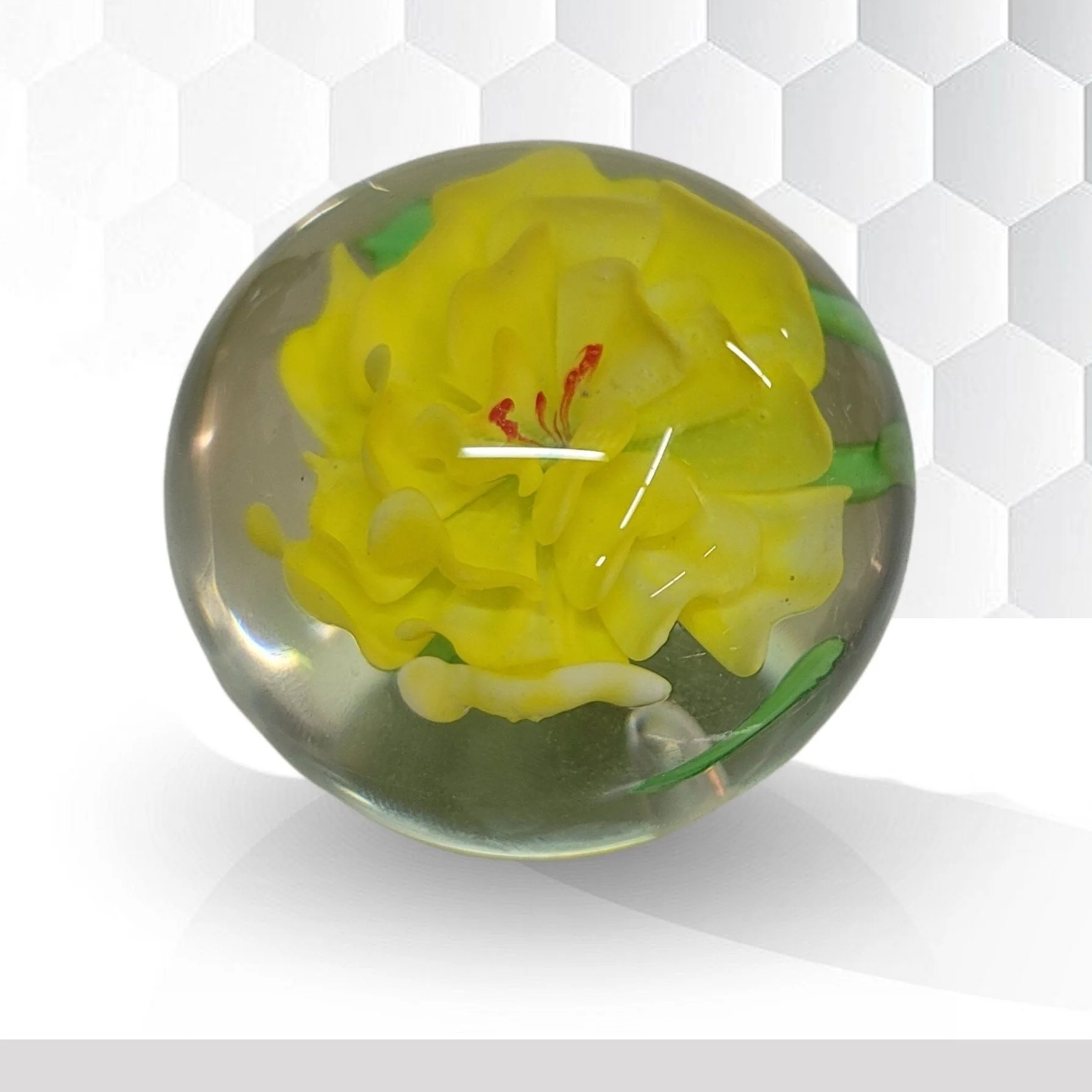
Paper weight Art Glass Murano Paperweight Yellow Flower
Beautiful Art Glass Murano Paperweight yellow flower 001
I purchased a collection of art glass paperweights and I will be offering them here as I go through the collection
each one is handmade and has such detail and beauty and is reminiscent of an era gone by when folks used to write letters
Millefiori (Italian: [ˌmilleˈfjoːri]) is a glasswork technique that produces distinctive decorative patterns on glassware. The term millefiori is a combination of the Italian words "mille" (thousand) and "fiori" (flowers).[1] Apsley Pellatt in his book Curiosities of Glass Making was the first to use the term "millefiori", which appeared in the Oxford English Dictionary in 1849; prior to that, the beads were called mosaic beads. While the use of this technique long precedes the term "millefiori", it is now most frequently associated with Venetian glassware.[2][3]
Since the late 1980s, the millefiori technique has been applied to polymer clay and other materials.[4] As the polymer clay is quite pliable and does not need to be heated and reheated to fuse it, it is a much easier medium in which to produce millefiori patterns than glass.[5]
Product Information
Product Information
Shipping & Returns
Shipping & Returns
Description
Beautiful Art Glass Murano Paperweight yellow flower 001
I purchased a collection of art glass paperweights and I will be offering them here as I go through the collection
each one is handmade and has such detail and beauty and is reminiscent of an era gone by when folks used to write letters
Millefiori (Italian: [ˌmilleˈfjoːri]) is a glasswork technique that produces distinctive decorative patterns on glassware. The term millefiori is a combination of the Italian words "mille" (thousand) and "fiori" (flowers).[1] Apsley Pellatt in his book Curiosities of Glass Making was the first to use the term "millefiori", which appeared in the Oxford English Dictionary in 1849; prior to that, the beads were called mosaic beads. While the use of this technique long precedes the term "millefiori", it is now most frequently associated with Venetian glassware.[2][3]
Since the late 1980s, the millefiori technique has been applied to polymer clay and other materials.[4] As the polymer clay is quite pliable and does not need to be heated and reheated to fuse it, it is a much easier medium in which to produce millefiori patterns than glass.[5]